Five Ingredients for Building a Culture of Innovation
Many organisations, both private companies and public institutions, struggle to create environments where innovation actually happens. Not because they lack ambition, and usually not because people are unwilling to try. The problem is often more basic: they don’t have the right conditions for creativity, experimentation and change to become part of everyday work.

Meet Strategic Advisor Henning Hovland from SOS Barnebyer, psychologist Vidar Ulset from Lysne Psykologene, and Innovation Lead Kjell-Vidar Åhman Teig from Yulieta by Innocode, as they discuss the five ingredients needed to create a culture of innovation in the workplace. (In Norwegian only)
Many organisations, both private companies and public institutions, struggle to create environments where innovation actually happens. That is often not because they lack ambition, and usually not because people are unwilling to try. The problem is often more basic: they don’t have the right conditions for creativity, experimentation and change to become part of everyday work.
This has become especially visible in the age of AI. Some organisations are already integrating AI into their processes, changing how they work and finding new ways to create value. Others make a few attempts, encourage people to “use AI more”, maybe run a workshop, and then nothing sticks. The technology is there. The culture often isn’t.
Everyone talks about AI in terms of efficiency, speed and new possibilities. But in practice, many people feel uncertain. Some feel behind. Some are afraid of doing it wrong. They hesitate and wait instead of experimenting and taking chances. So why do some teams actually make progress, while others get stuck?
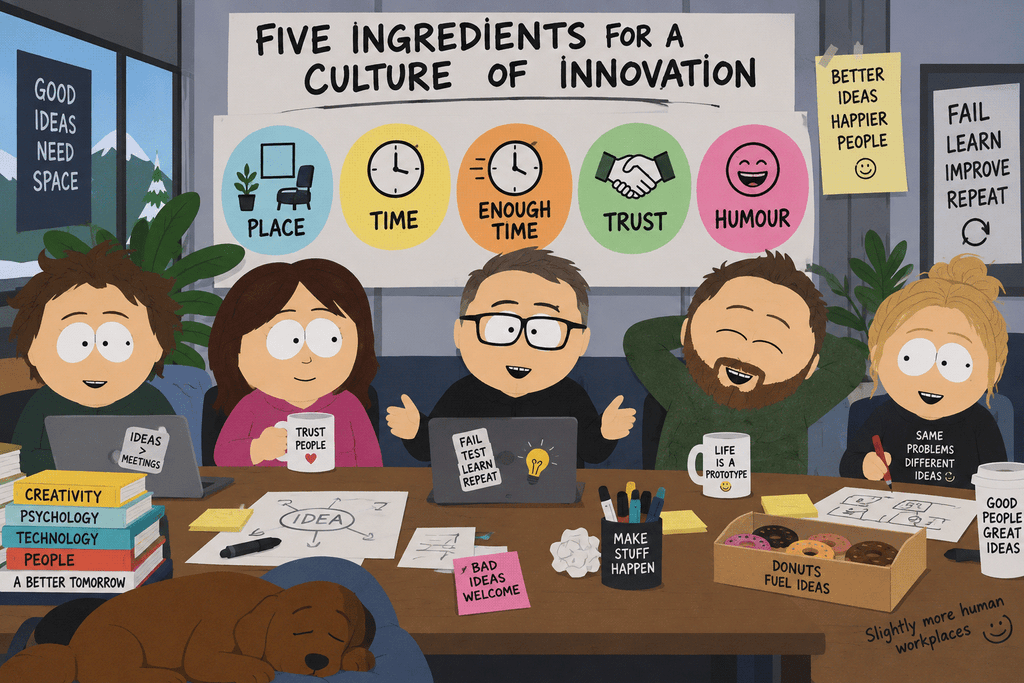
I believe it comes down to five ingredients: place, time, (enough) time, trust and humour. You need all five. Not one or two. All five working together. Because innovation is not something you get by telling people to be more creative. It happens when you build an environment where ideas are allowed to appear, be tested, fail, improve and eventually become useful.
1. Place
We are creatures of habit, and the places we work in shape the way we think. A writer may have a writing room, a musician has a studio, and a good workshop often needs a room where people can move around, put things on the walls and make a bit of a mess. The room itself is not magical, but over time it becomes a signal. When you enter that space, your brain understands what kind of work is supposed to happen there.
For instance, office landscapes can be difficult for creative work. Creativity often requires trying and exploring bad ideas. You need to make mistakes, test many directions and follow half-baked thoughts for a while. That becomes harder when people are constantly walking behind you and glancing at your screen.
A creative space does not need to be an expensive innovation lab. It can be a meeting room, a phone booth, a café, a cabin, a home office or a corner where people know they should not disturb you. What matters is that the place gives focus, has the tools you need, and creates enough privacy to try before the idea is ready to be judged.
2. Time
You must plan for working with innovation. There is a stubborn myth that creativity is something you wait for, as if inspiration suddenly appears and tells you when to work. Of course spontaneous ideas happen. They may come in the car, on the train, in the shower or while you are pretending to listen in a meeting. But those spontaneous ideas usually come because you have already spent time working on the problem.
You cannot just wait for ideas to find you. You have to go looking for them. That means putting creative work in the calendar and treating it as real work, not something you do when everything else is finished. Because everything else is never finished. If innovation is important, you need to decide when innovation happens.
3. Time
You must set enough time. This is where many organisations fail. They say they want innovation, but then give people one hour here and there, squeezed between meetings, emails, Slack messages and customer requests. That is not innovation time. That is leftover time, and you do not build a culture of innovation from leftovers.
Creative work takes time to warm up. Sometimes it can take 20 minutes just to get properly into flow. So if you are interrupted every ten minutes by someone who “just has a quick question”, you never get deep enough to do anything meaningful. You stay on the surface, choose the obvious ideas and produce safe solutions because there is no time to find the better ones.
One hour is often the minimum, and longer blocks are usually better. Deadlines can also help, as long as they are realistic. A good deadline creates movement and forces decisions. It helps you stop ideating forever, because innovative work is rarely truly finished. At some point you have to deliver, abandon the work and move on. But before that point, people need enough time to actually do the work properly.
4. Trust
Innovation involves failure, because that is frankly how reality works. You try something, it does not work, you learn something, and then you try again. If your culture punishes mistakes, people will stop experimenting. If people are afraid of looking stupid, they will not share unfinished ideas. If every attempt has to become an immediate measurable success, people will choose the safest path.
Trust means people can say “I don’t know”, “let’s test it” or “this is not finished, but I want your thoughts” without fear. It also means feedback has to be handled well. Creative work gets better when you invite others in early, because colleagues can see what you have become blind to. They can ask the annoying question that turns out to be the right one. But if judgement comes too early, the idea dies before it has had a chance to fly. You need to explore first and evaluate later. First you create choices, then you make choices.
5. Humour
Don’t take yourself so f*cking seriously. This one is often underestimated. Many people believe that serious problems require serious rooms, serious faces and serious language. I understand why, but it often has the opposite effect. When everything becomes too serious, people become careful, defensive and afraid of saying something wrong. And that makes it much harder to come up with good ideas for serious problems. We put our brains in locked mode.
Humour changes the temperature in the room. It opens people up and lowers the threshold for participation. It makes it easier to suggest something strange, unfinished or risky. Humour is about creating an open mindset where people can play with thoughts before they have to defend them.
You need them all
The challenge is that most organisations only do some of this. They create a room, but no time. They give people time, but not enough of it. They talk about failure, but punish it in practice. They ask for bold ideas, but respond to the first strange suggestion with a sigh, a glance at the clock or “we don’t have budget for that.” Then they wonder why people stop contributing.
Creativity and innovation are surprisingly easy to kill. A yawn can do it. A bad comment can do it. A leader who wants to “get to the point” too early can do it. The five ingredients work together. Place without time is just an empty room. Time without trust is all about fear. Trust without structure could result in insecurity. And humour for no reason is just... stupid, I guess.
If you want people to use AI, experiment with new technology and build better solutions, you shouldn’t just tell them to be innovative. You should create the conditions that make innovation possible: a place to focus, time in the calendar, enough time in the calendar, trust to fail and learn, and humour to keep the mind open.
Relevant stuff

The Generalist – the Master of the New Universe?
Could Artificial intelligence be reshaping the value of skills in the workplace, shifting the advantage from specialists to generalists?