Pre-Projects Are Changing in an AI-Driven Market
The way digital products are built is obviously changing rapidly. AI is accelerating product development, lowering technical barriers, and increasing the speed at which markets evolve. In this environment, traditional pre-projects are changing.
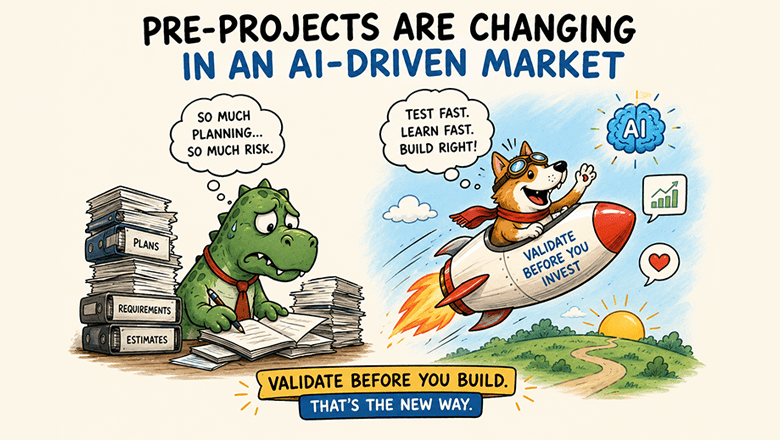
Historically, pre-projects focused on defining the solution upfront:
- Product vision
- Requirements gathering
- Backlog creation
- Architecture planning
- Development estimates
This approach made sense in a slower-moving market where assumptions remained stable for longer periods of time. Today, that is no longer the case.
Markets shift faster. User expectations evolve faster. AI capabilities change almost monthly. A product idea that looks strong during planning can quickly lose relevance before development even starts.
The biggest issue with the traditional pre-project model is that validation often happens too late — after significant time and budget have already been committed.
That creates unnecessary risk:
- Building solutions before confirming real demand
- Investing heavily in assumptions
- Spending months planning features that could have been tested first
- Discovering too late that users behave differently than expected
In today’s environment, the goal of a pre-project is no longer just to define what to build.
It is to determine whether something is worth building at all.
Read more about Launchpad, our way of running pre-projects
The Shift Toward Validation-Driven Pre-Projects
Modern pre-projects need to focus less on detailed specification and more on fast validation and learning. Instead of attempting to fully define a future product upfront, the process should begin with clear hypotheses:
- What problem are we solving?
- Who experiences it?
- Why would they care?
- What behavior would validate the opportunity?
- Can AI or technology meaningfully improve the process or experience?
From there, the focus shifts toward creating targeted Proofs of Concept (PoCs) designed to test those assumptions quickly. The purpose is to reduce uncertainty before larger investments are made.
Core Principle: validate before scaling development.

The New Role of the Pre-Project
This changes the role of the pre-project fundamentally.
Before
The pre-project primarily focused on:
- Defining scope
- Writing requirements
- Planning architecture
- Estimating delivery
Now
The pre-project focuses on:
- Identifying the highest-risk assumptions
- Testing real user value
- Validating technical feasibility
- Exploring AI opportunities realistically
- Generating evidence for decision-making
The outcome moves from simple documentation to real insitghts.
Read more about Launchpad, our way of running pre-projects
The Role of the PoC (Proof of Concept)
The PoC becomes a central part of the modern pre-project.
A PoC is:
- A focused test of key assumptions
- A fast and practical learning tool
- A way to gather real-world signals early
- A demo-ready artifact connected to a specific hypothesis
A PoC is NOT:
- An MVP
- A production-ready system
- A full-featured product
Its purpose is to answer critical questions such as:
- Do users actually care about this?
- Will they engage or convert?
- Is the concept technically viable?
- Does AI create meaningful value here?
- Is this worth further investment?
Instead of relying primarily on planning and assumptions, companies gain evidence early in the process.
Why This Matters More in the AI Era
AI is changing not only how products are built, but also how quickly they can become obsolete.
This creates both opportunity and pressure:
- Products can be developed faster than ever
- Competitors can move faster
- User expectations evolve faster
- Technical possibilities change continuously
As a result, the cost of building the wrong thing increases. Modern pre-projects therefore need to optimise for learning speed, not documentation volume. The companies that succeed are often not the ones with the most detailed upfront plans, but the ones that validate assumptions and adapt the fastest.
A Simple but Fundamental Shift
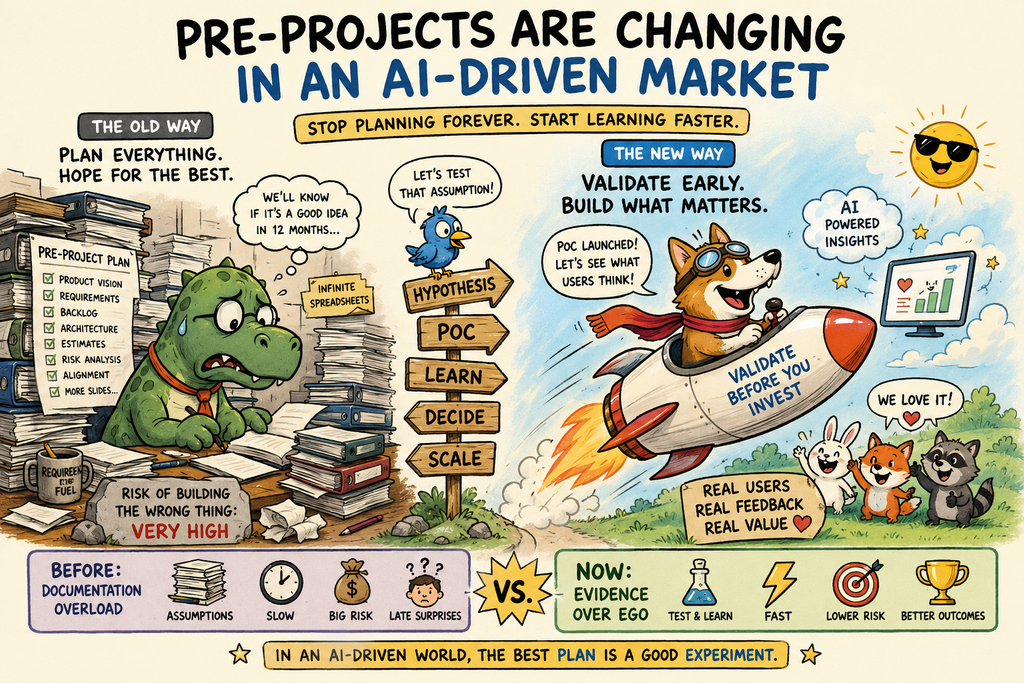
The shift in modern pre-projects is simple, but fundamental.
We move from simply defining what to build to proving what is worth building
This approach helps companies:
- Reduce wasted investment
- Improve product-market fit
- Make evidence-based decisions earlier
- Increase confidence before scaling
- Move faster in uncertain markets
In a rapidly changing AI-driven landscape, the ability to validate ideas early is becoming one of the most valuable parts of any digitalisation or product development initiative.
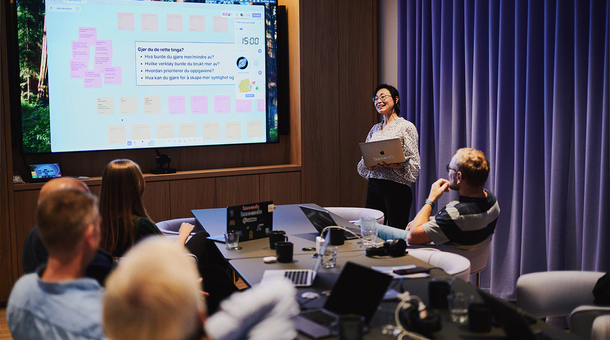
Launchpad: from idea to launched product in no time
Going from an idea to something defined, validated and launched like a Minimum Baseline Product (MBP) is easier than ever. However, it still takes more than an idea and enthusiasm alone. To really succeed you need to understand what problem you are solving, a story to tell, a shared direction and

Pitching, branding and story: When everyone is vibe-coding, how do you stand out?
We are emotional beings making emotional decisions. Yet we continue to communicate as if logic comes first.