AI is reshaping software development
by taking over much of the repetitive, standard tasks that make up most of a developer’s day.

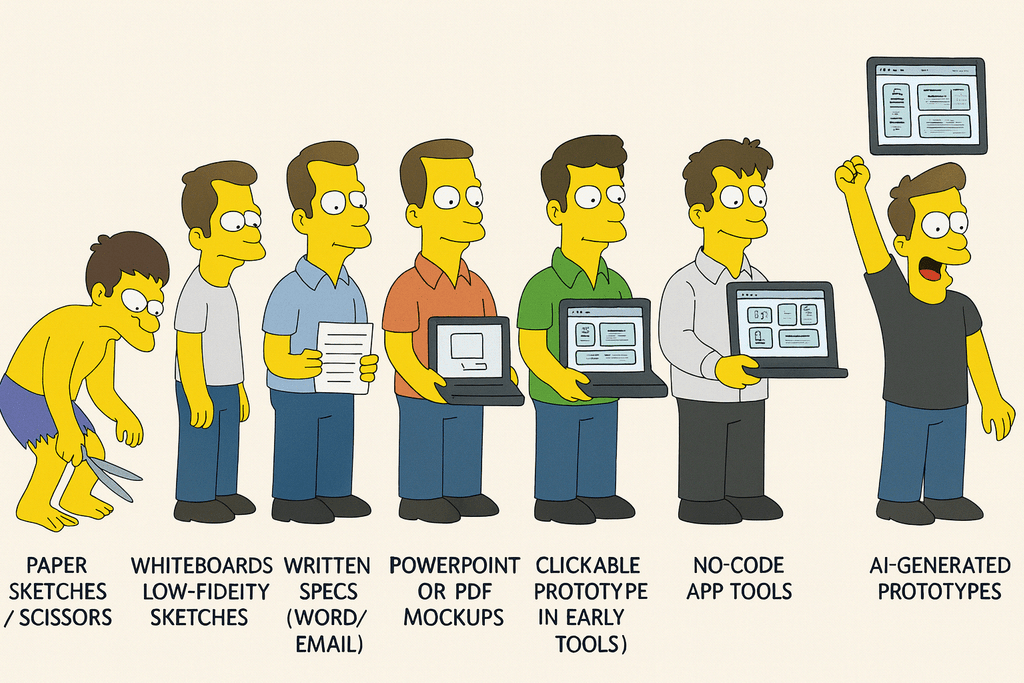
Recently something has been happening in our meetings with clients. Startups, entrepreneurs, founders, they all walk in with the same thing: a prototype. Not a PDF like they used to, not even a Figma sketch, but a working prototype.
Sometimes it’s half-broken, sometimes it’s surprisingly good, and sometimes it’s like someone put together five tutorials, ten ideas and just wished for the best. The quality varies, but the fact that these prototypes exist at all says a lot about where software development is heading. They don’t replace engineering, but they do accelerate early exploration. And fear not, AI isn’t replacing developers. It’s reshaping what the role means and opening the door for non-technical people to join the party.
Boring disappears?
If we apply the 80-20 rule, we could say that 20% of development is deep problem-solving and 80% is routine work. “Let’s hook up another API and add another modal.” Of course, even the “routine” parts hide complexity, edge cases, and security considerations, but that doesn’t change the fact that much of the work feels repetitive. Luckily we see AI doing more and more of that 80%.
Not because developers can’t do it, but because nobody should have to spend half their career doing the same chores over and over again. AI tools are good at spinning up predictable code: payment flows, CRUD screens, basic dashboards, integrations, onboarding steps. Not production-ready versions, those still need compliance, architecture, and verification, but fast drafts that help teams move quicker.
So instead of asking, “What will developers do when AI handles the repetitive stuff?” ask, “What do developers do when the baseline is already built?”
Will product owners do more on their own?
A few years ago, product owners would brainstorm, write specs, make flows, and then hand it all over to engineering.
Now they often arrive with something half-working. Tools like Lovable, Mocha, Vercel’s AI workflow, and countless smaller AI builders make it easy for non-developers to test ideas, design flows, or create MVPs and prototypes. For them, it’s perfect for early exploration.
It means the first conversation with engineering is no longer a blank page. It’s more like:
“We tested three different user journeys.”
“This prototype breaks when users do X.”
“This flow is confusing, can we simplify it?”
Of course, these prototypes can also introduce technical debt, wrong assumptions, or unclear ownership if treated as “real” software. They will act more like guidance, but they still save time for the more exciting parts of the project.
"The most important skill for developers isn’t just technical ability; it’s a more strategic understanding of what clients truly need, and the ability to empathise with them. Even in a tech world, trust and human connection remain the strongest assets we have."

A “product engineer”?
With AI writing larger chunks of functional code, a hybrid role is emerging, not because someone invented it, but because the workflow demands it. And in reality, this role isn’t new. Many teams have worked this way for decades. What’s new are the tools and the speed.
The product engineer:
- understands the user
- sees the product through a business lens
- can talk design, logic, and architecture
- can use AI to build early versions
- can review, refactor, and turn AI output into something real
Call it a “product engineer,” “product developer,” or “technical product owner.” The name doesn’t matter, but what they do does.
What’s disappearing is the old way of handing over tasks from one expert to another. AI tightens the project flow and make it faster: explore → build → validate → rewrite → refine.
So what could developers be merging into?
The developers who thrive in this new digital environment will:
- use AI to remove friction
- keep the human judgment layer
- understand the product, not just the code
- lean into architecture, debugging, modeling, experimentation
- stay curious instead of protective
- balance rapid generation with verification, security, and consistency, the parts AI still can’t handle well
The times are a-changing
We know that product owners will show up with pre-tested prototypes and a broader understanding of customer needs. They will show us their vibe-coded prototypes or even launched beta-products. But vibe-coding isn’t engineering, and shouldn’t replace it, it informs direction, not delivery.
We change our approach to match market needs. We adapt and evolve to move faster, build smarter, and deliver better products. Open minded and curious. We embrace change and dare to push the conventional view of what it means to be a developer. At the same time, we recognise that verification, security, compliance, and architecture don’t go away just because generation is faster.
Oh, one final thing: anyone claiming they know exactly where all of this is heading is lying. No one knows. However, we can only make qualified guesses. And it’s still early, but improving rapidly.