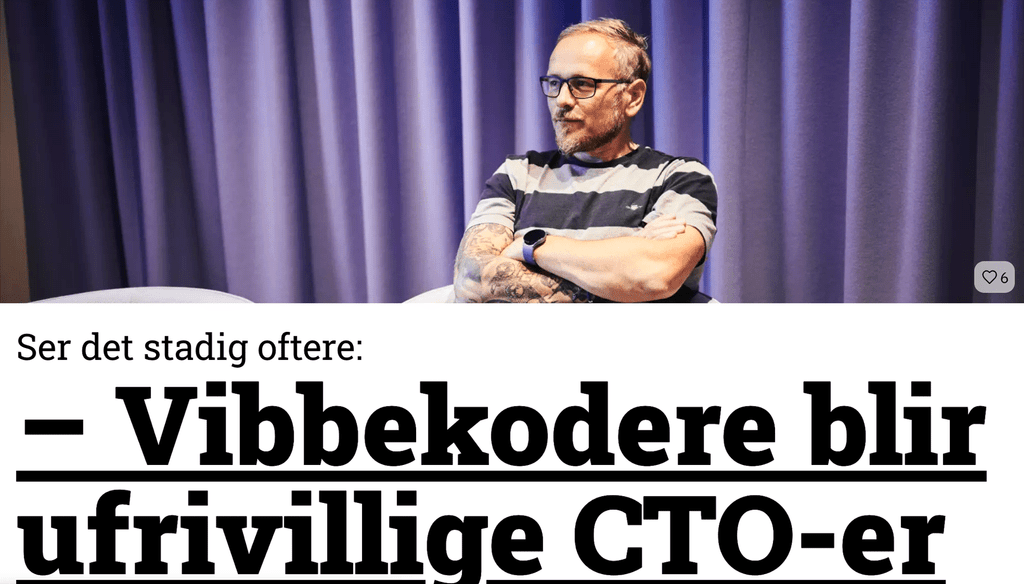
The Accidental CTO
In the past, building a digital product was a big deal. You needed developers, designers, strategists, a product owner, a budget, and an awful lot of time.

Today you open an AI tool, describe your idea, and boom — you’ve got something resembling a working product before the workday is over. So why pay for a SaaS solution that does almost what you need, when an employee can whip up something of their own that solves your exact problem in no time?
More and more people are becoming aware of the power of AI tools, and naturally the pendulum is swinging toward building more (everything?) ourselves. But a pendulum tends to swing back again, and in this case it will, once we’ve learned more about what happens after we’ve vibe-coded our way to our dream solution. When we’re looking at the results, did the AI cretion turn out to be what we intended?
I see it more and more often in meetings with customers and potential partners. They’ve built something themselves. Vibe-coded it into existence with an AI tool. They’ve solved an annoying problem, and their colleagues love it. Word spreads and more users flock to it. Another department wants access too. It smells like success. Then the solution gets connected to a CRM, and suddenly there’s a lot of sensitive data in the system. A manager discovers how useful the tool is and asks whether it could perhaps be offered to customers as well. Your little experiment has become something the entire company depends on.
The questions that should have come before you built anything tend, in these cases, to come afterward instead. Who is actually responsible for the solution that took you an afternoon to build? Who looks after security? What happens when an integration stops working? Who handles API changes and makes sure data is processed correctly and safely? Who documents the solution? And what happens the day the person who built the whole thing quits?
Congratulations, you’re our new CTO!
The only problem is that the eager vibe-coder already had a job. Maybe in sales, finance, communications, HR, or innovation. This person was simply curious, a bit fearless, and good at making things work. That makes AI a perfect match.
And when the tool actually turns out to do the job better and gains a growing user base, the requests naturally follow. Can we get a button here? Can it be connected to Teams? Can customers log in? Can we send data to the finance system? Can we just add national ID numbers too?
Suddenly, you — who took it upon yourself to build a solution to make your own job more efficient — are also the one managing it. Because of your curiosity, you’ve become the organization’s involuntary CTO, and the organization has acquired yet another software system that has to be kept alive.
Do you even need a tech partner now that you can build everything yourself?
The pendulum is swinging back to a world where we get better at understanding what we should actually build ourselves and what we should leave to someone else.
Sometimes you should build it yourself, while other times a SaaS solution that meets your need already exists. And sometimes that little experiment has become so important, complex, or business-critical that it needs people who genuinely understand the technology and can take responsibility for it.
The role of development partner will probably change to be more about strategic decisions and product development at a higher level. When should you buy an off-the-shelf solution, and when should you build it yourself? And what happens when your little experiment has actually become a product that must be managed according to all the requirements of security, scaling, good UX, UI, uptime, and so much more?
Of course, we’ll build more ourselves in the future. But we’ll also rediscover why standardization and proper management have value. Security, documentation, updates, integrations, support, and continuity are incredibly exciting things for everyone — but it’s incredibly nice when someone who actually knows what they’re doing is responsible for them.
It’s a bit like Spider-Man, really: with great power comes great responsibility.
And apparently that also applies to that AI solution you just threw together after work out last Thursday.
Read the story on kode24.no (Norwegian only)