The Competence Paradox
I can ask an AI to visualize a model I’m about to present, and within seconds get something that’s almost exactly what I wanted. But when I try to fine-tune the result, the fun usually ends.
I ask the AI to move a piece of text. It moves the wrong text. I try again, and it removes a visual element. I explain more clearly what I want. It fixes the text, but moves all the other text at the same time. After a few rounds, I tell the AI to go to he... somewhere far, far away. I should have just done it myself in Photoshop, Illustrator or Canva (yes, even a bona fide designer can use Canva these days).
I'm first and foremost a concept developer, marketer and designer, not a developer. My coding experience ends roughly at swapping out URLs in a newsletter's HTML ages ago. Even after almost twenty years working closely with developers, they're the ones who know the code, not me.
When AI makes mistakes within my own field, it's easier for me to spot them. Precisely because I know design. I have the experience and know how I would have solved the problem myself, or at least how I would have gone about finding a solution. That's why I can judge whether the AI actually solved my task well.
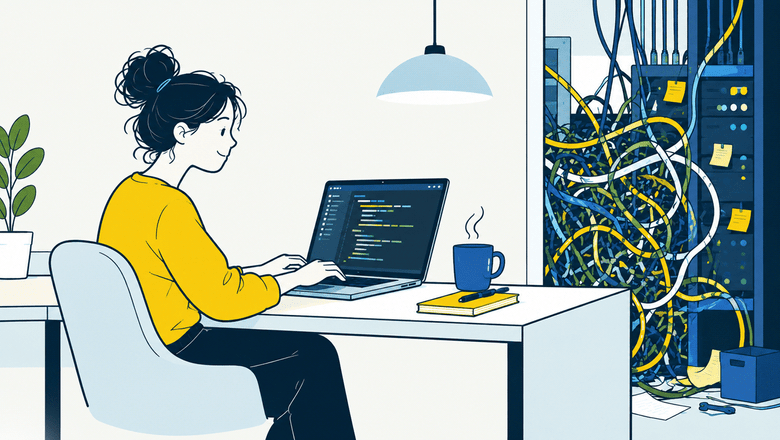
When I vibe-code, on the other hand, I haven't got a clue. I can test whether the login works, but I can't judge whether the authentication has been implemented securely. I can see that data is being stored, but I know little about database structure, scaling or how personal data is handled. It looks fine. It works. I think.
I can't see what the AI gets wrong
AI is obviously most valuable when it does things I can't do myself. The problem is that this is also when I'm least equipped to know whether it's getting things wrong.
That doesn't mean professional developers always deliver perfect code either. The difference is that an experienced developer is far better equipped to evaluate what the AI produces. They can spot poor architectural choices, security holes and technical debt, and they know what happens when a solution has to work for ten thousand users instead of ten. AI amplifies the expertise you already have, without necessarily replacing it.
We're also seeing AI change what our clients ask for. They're buying far less of the simple development work: lightweight MVPs, CRUD applications, generic frontend and manual QA. The price of pure production capacity is being pushed down. At the same time, interest is growing in integrations, security, compliance, modernization and cleaning up AI-generated code.
It's actually quite logical: If what used to take ten people can now be done by five, it becomes hard to sell ten people.
We're seeing changes in the labour market too. Swedish researchers at Örebro University found that employment among 22–25-year-olds in AI-exposed occupations, such as software development, fell by 5.5 percent compared with less exposed occupations after ChatGPT arrived. For those over 50, it rose by 1 percent. This is probably just the beginning.
In Norway, BI Norwegian Business School and the Frisch Centre see a similar pattern. They find no general AI jobs crisis, but they do find a decline among young workers in the most AI-exposed occupations.
AI may not replace junior developers entirely, but it raises an interesting question: If we increasingly use AI to do the tasks that used to be done by less experienced developers, how are they supposed to gain the experience that enables them to evaluate what the AI produces?
PwC points to something similar in its Global AI Jobs Barometer 2026. In US data, the most AI-exposed entry-level roles far more often ask for skills we tend to associate with senior people, such as judgment and leadership. Expectations of our aspiring juniors are changing.
We value experience ever more highly, while making it harder for people to gain the very experience we're looking for.
I suppose this is the competence paradox from another angle. AI makes it easier to perform tasks that used to require specialized expertise, while the expertise needed to evaluate the result becomes ever more valuable.
The real value is shifting from producing code to evaluating it. "From hands to heads," as some might say.
Next time I lean back with chocolate, coffee and a big smile on my face because the AI tells me everything is sunshine and rainbows, maybe I should ask myself a question: Do I actually know that it works, or do I just lack the expertise to notice that it doesn't?
Sources
- Örebro University and Ratio (2026) – employment among young people in AI-exposed occupations.
- BI Norwegian Business School and the Frisch Centre, the AI Index (2026) – AI and developments in the Norwegian labour market.
- PwC Global AI Jobs Barometer 2026 – changing skill requirements in entry-level roles.