Seems You Will Not Lose Your Job After All… Or, Will You?
Every time humanity experiences a major technological breakthrough, we seem to repeat the same pattern. A new invention appears. Headlines predict a revolution. Experts confidently explain how everything will change. People panic. Entire professions are supposedly doomed. Society, as we know it, is about to disappear.
It happened during the Industrial Revolution when workers destroyed machines and factories out of fear that automation would leave everyone unemployed. It happened when the spinning jenny transformed textile production. It happened with tractors, automobiles, computers, the internet, marketing automation, social media, and countless other innovations.
Each time, the narrative was similar: "This changes everything." And, to be fair, it often did. The world changed. Industries evolved. New jobs emerged while others disappeared. Workflows became more efficient. Entire business models were reinvented. But something else happened too: we adapted.
We didn't run out of work. We didn't become obsolete. In fact, many of us are busier today than ever before. Ironically, technologies that promised to save time often ended up increasing expectations, accelerating pace, and creating entirely new categories of work. Now we're living through the AI era.
Just a few years ago, many predicted a jobs apocalypse. AI would replace knowledge workers. Entire professions would vanish. Humans would become spectators while machines did the work. Today, the buzzword has shifted from AI itself to AI agents. The narrative, however, feels familiar. Three years later, reality looks more nuanced. Has AI changed how we work? Absolutely. Will it continue to change how we work? Without question. But has it made people redundant? Nope.
That doesn't mean nobody is affected. Every major technological shift creates winners and losers, and some roles inevitably disappear. But history suggests that adaptation is usually a bigger force than replacement.
Personally, I use AI every single day. It has dramatically improved my productivity and streamlined many parts of my workflow. Tasks that once took hours can now take minutes. Yet I don't have less to do. If anything, I have more opportunities, more ideas to pursue, and higher expectations than before.
Perhaps the strongest sign of this uncertainty is that even some of AI's most important leaders are changing their predictions. OpenAI CEO Sam Altman recently admitted that the "jobs apocalypse" he once expected has not materialized. He said that human interaction remains an essential part of work and that the impact on employment has been far slower and more complex than many anticipated.
I mean, we are great at predicting technological disruption, but really bad at predicting how humans will adapt to it.
Great to know, right? When the next jobs apocalypse come... trust me, it will not happen :)
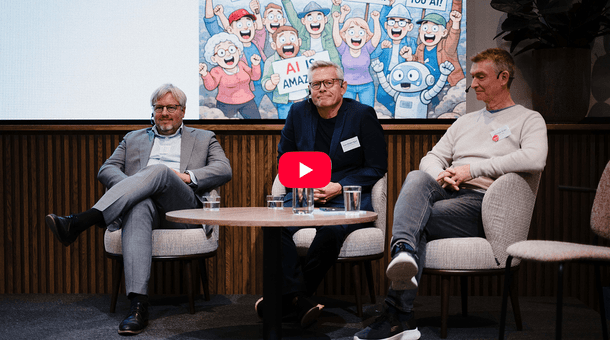
Citizen 2026: Agile innovation and the new technology landscape
How can municipalities move innovate more efficiently while still staying in control with new technology?

The Accidental CTO
In the past, building a digital product was a big deal. You needed developers, designers, strategists, a product owner, a budget, and an awful lot of time.