Atiloop food waste prototype
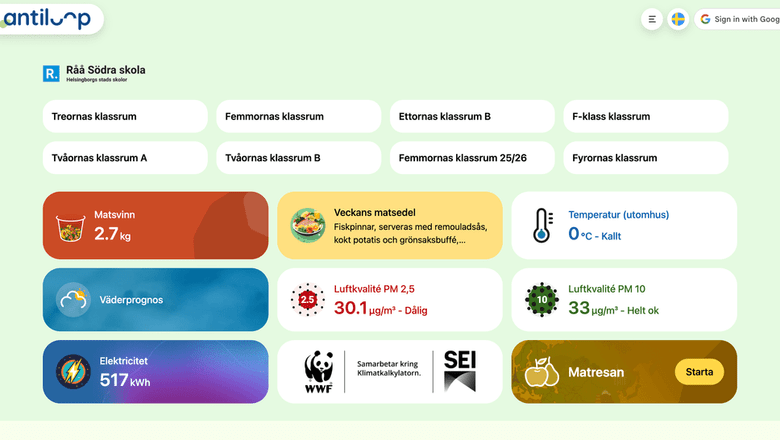
Antiloop is an educational platform designed to help school students better understand climate and environmental impact through data from their own school environment. Its interactive school dashboards bring together information from IoT sensors and other widgets, making environmental data more concrete, relatable, and easier to discuss in the classroom.
What?
Antiloop is an educational platform designed to help school students better understand climate and environmental impact through data from their own school environment. Its interactive school dashboards bring together information from IoT sensors and other widgets, making environmental data more concrete, relatable, and easier to discuss in the classroom.
The Antiloop platform is intended to turn real school data into a learning tool that supports both environmental awareness and curiosity about technology. One example is food waste, where daily waste can be transformed into more tangible comparisons for students, helping them understand the scale of waste in a familiar way.
Why This Prototype Was Created
Within that broader ecosystem, this food-waste prototype was created to solve a practical implementation gap.
Some schools already had food-waste systems that could be integrated into Antiloop, while others did not. For those schools, there needed to be a simple and accessible way for staff to report food-waste data manually so it could still feed into the Antiloop dashboards.
This prototype was built as that missing input layer: a lightweight reporting tool that made it easy for users to log daily food-waste data in a structured format.
Core Functionality
The prototype focused on capturing reliable unit-level food-waste data rather than presenting advanced analytics inside the app itself.
Users could enter daily food-waste records including:
- Date
- Waste amount (grams)
- Attendee count
This created a structured dataset that could later be visualised in Antiloop.
Additional functionality included:
- Record history
- Date-based filtering
- Per-person waste calculations
- Location and unit management
- User invitations
- Role-based access
- API credential management
Together, these features helped ensure that schools could submit consistent and reusable environmental data into the broader Antiloop ecosystem.
Role Within the Antiloop Ecosystem
In the final service design, the prototype acted as a bridge between operational reporting and educational visualisation.
Rather than functioning as a standalone product, it enabled schools without existing food-waste infrastructure to still contribute structured data into Antiloop. This expanded the platform’s ability to visualize environmental impact across a wider range of schools, allowing more students to see their own school’s environmental footprint reflected in classroom dashboards.
This positioning is partly based on the broader Antiloop project description and partly on the implementation context surrounding the prototype itself.
How It Was Built
Fast Prototype Development
A key part of this project was speed.
The prototype was designed and implemented within just three days, with the primary goal of validating the workflow and concept quickly rather than building a fully scaled production system.
To support that pace, the development process relied heavily on AI-assisted and agentic engineering workflows. These workflows helped accelerate:
- Scaffolding
- Iteration
- Implementation
- Debugging
- Technical decision-making
Technology Stack
The tech stack was chosen to support rapid prototyping without sacrificing the essentials needed for a real working product.
Next.js
Next.js was used as the primary framework because it allowed the prototype to combine: frontend UI, server-side logic, routing, API endpoints etc within a single codebase.
This simplified development while still supporting authentication, protected routes, admin flows, and public data access.
Supabase
Supabase was selected as both the database and authentication provider, with data hosted in the North EU region (Stockholm).
This enabled rapid setup of:
- User authentication
- Invitation flows
- Password setup
- Role-based access
- Structured database storage
It also provided a practical way to manage food-waste records, units, locations, and API credentials in one place without needing to build backend infrastructure from scratch.
Outcome
The combination of Next.js, Supabase, and AI-supported development made it possible to deliver a functioning prototype in a very short timeframe.
The result was not just a visual mockup, but a working reporting tool with:
- Real authentication
- Structured data capture
- Administrative management flows
- Integration-ready APIs
This allowed the prototype to function as a practical operational layer within the broader Antiloop ecosystem while supporting future educational visualization inside the platform.
// By Andrii Pashko

AntiLoop – a climate tool for children and youth
AntiLoop is a digital tool designed and developed for children and youth. Using data from IoT sensors placed around and inside schools, students get insight into how daily behavior and activities affect the climate around them.
Five Ingredients for Building a Culture of Innovation
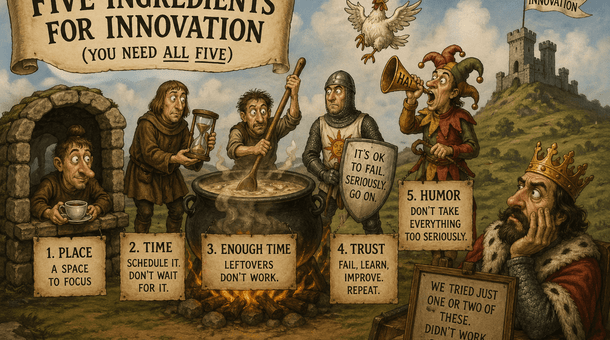
Many organisations, both private companies and public institutions, struggle to create environments where innovation actually happens. Not because they lack ambition, and usually not because people are unwilling to try. The problem is often more basic: they don’t have the right conditions for cre